
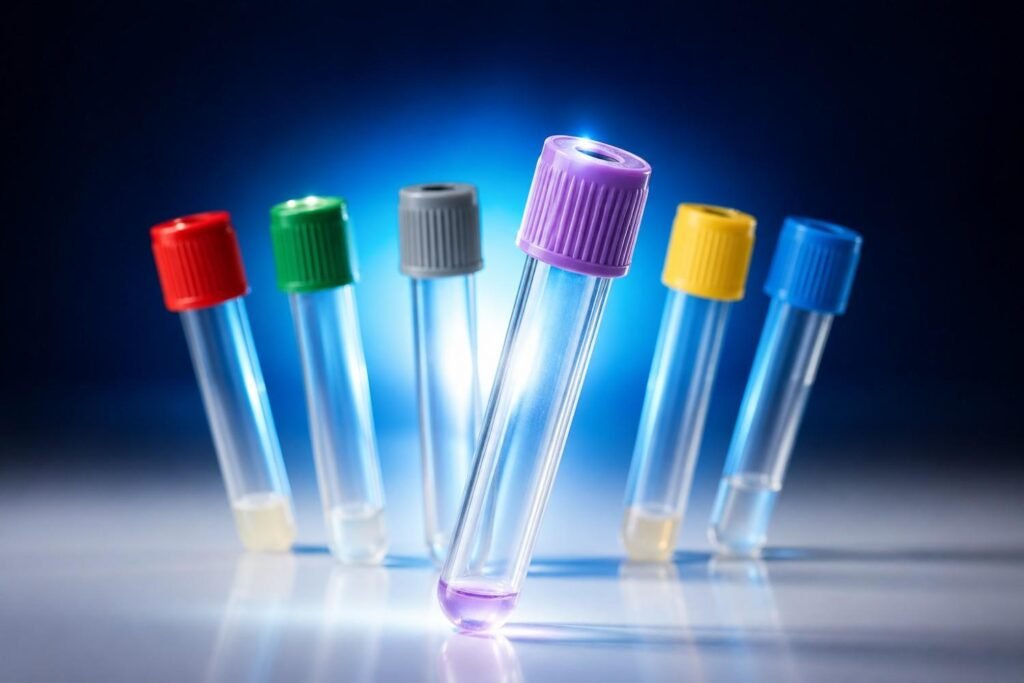
Blood collection tube colors follow a standardized system that every phlebotomist, nurse, and lab technician must know. Each color identifies the specific additive inside the tube — and using the wrong tube for a test produces incorrect results, requires recollection, and can delay patient care. This complete guide covers all 9 blood collection tube colors, their additives, the tests each tube is designed for, and the correct order of draw
Every time blood is collected for laboratory testing, the type of tube used matters as much as the collection technique itself. Blood collection tubes use a standardized color-coding system — established by CLSI (Clinical and Laboratory Standards Institute) — to identify the additive inside each tube. Using the wrong tube for a test produces incorrect results, requires recollection, and can delay diagnosis and patient care.
This guide covers all nine blood collection tube colors used in US clinical laboratories: the additive in each, why that additive is used, which specific tests each tube is designed for, special handling requirements, and the complete order of draw. Whether you are studying for the phlebotomy certification exam, training as a nursing student, or working as a lab technician, this is the reference guide you need.
Why Blood Collection Tube Color Coding Matters
Each blood collection tube contains a specific additive — or no additive at all — that either prevents clotting, promotes clotting, or preserves specific analytes in the sample. The wrong additive can:
- Interfere with test chemistry: EDTA chelates calcium and magnesium, so using a purple-top tube for a calcium or magnesium assay produces a falsely near-zero result.
- Produce the wrong sample type: Some tests require serum (clotted blood); others require plasma (anticoagulated blood). Using a clotting tube where plasma is needed, or vice versa, renders the sample useless.
- Cause carryover contamination: Drawing tubes in the wrong order allows trace amounts of one tube’s additive to contaminate the next tube, altering results — especially critical for coagulation testing.
The color-coding system eliminates ambiguity at the point of collection, allowing phlebotomists and nurses to identify the correct tube instantly without reading small labels.
Complete Blood Collection Tube Color Chart — All 9 Tubes
| Cap Color | Additive | Sample Type | Primary Tests |
| Yellow | SPS (Sterile) | Whole blood | Blood cultures |
| Light Blue | Sodium citrate | Plasma | PT, INR, aPTT, coagulation studies |
| Red (plain) | None | Serum | Serology, blood bank, some chemistry |
| Gold / SST | Clot activator + gel | Serum | Chemistry panels, hormones, LFTs, lipids |
| Green | Lithium or sodium heparin | Plasma | STAT chemistry, ammonia, chromosomes |
| Purple / Lavender | K2EDTA or K3EDTA | Whole blood | CBC, blood smear, HbA1c, blood bank, DNA/PCR |
| Pink | K2EDTA | Whole blood | Blood bank, type and screen, crossmatch |
| Gray | Sodium fluoride + potassium oxalate | Plasma | Glucose, lactate, blood alcohol |
| Royal Blue | EDTA or clot activator (trace metal free) | Plasma or serum | Trace metals, toxicology, nutritional studies |
| Yellow ACD | ACD (acid-citrate-dextrose) | Whole blood | Blood bank, HLA typing, paternity testing |
| Tan | K2EDTA (lead-free) | Whole blood | Lead testing |
Tube cap colors can vary slightly between manufacturers (BD Vacutainer vs Greiner vs Sarstedt). Always verify additive type from the tube label rather than cap color alone when working with an unfamiliar brand.
Each Tube in Detail — Additives, Uses, and Special Handling
1. Yellow Top Tube — Blood Cultures
Additive: Sterile SPS (sodium polyanethol sulfonate) anticoagulant in specialized blood culture bottles.
Blood culture bottles are the first tubes collected in every multi-tube blood draw. They receive blood before any other tube to ensure the sample is not contaminated by additives from other tubes and to minimize the risk of introducing skin bacteria during the draw. Blood culture collections are used to detect bacteremia (bacteria in the blood) and fungemia (fungi in the blood) in patients with suspected sepsis or infection.
- Always drawn first: Before any other tube in the order of draw.
- Special handling: Use strict aseptic technique — the skin must be cleaned with 70% isopropyl alcohol followed by a chlorhexidine or povidone-iodine solution before drawing blood cultures.
- Volume requirement: Most blood culture bottles require 8–10 mL per bottle; pediatric bottles require less. Volume accuracy is critical for sensitivity.
2. Light Blue Top Tube — Coagulation Studies
Additive: Sodium citrate (3.2% solution) — a reversible calcium chelator that prevents clotting by binding calcium without destroying coagulation factors.
The light blue tube is essential for all coagulation testing. Sodium citrate is chosen specifically because it preserves coagulation factor activity while preventing sample clotting. When the laboratory adds calcium back to the plasma during testing, the coagulation reactions can proceed normally for accurate measurement.
- Must be filled exactly to the line: The citrate-to-blood ratio of 1:9 is critical. Underfilling creates excess anticoagulant relative to blood, artificially prolonging all coagulation results. This is the most common pre-analytical error in coagulation testing.
- Common tests: PT (prothrombin time), INR, aPTT (activated partial thromboplastin time), fibrinogen, D-dimer, Factor assays including Factor VII activity test.
- Processing: Must be centrifuged at 1,500–2,000 × g for 15 minutes to produce platelet-poor plasma. Process within 1–4 hours of collection.
- Butterfly needle rule: When drawing only a light blue tube using a butterfly (winged) needle, draw a discard tube first to clear the air in the tubing before the citrate tube fills — preventing dilution.
3. Red Top Tube — Plain (No Additive)
Additive: None — the tube is completely plain glass or plastic.
The plain red top tube allows blood to clot naturally. After a clot forms, the tube is centrifuged to separate serum (the liquid portion after clotting factors and cells are removed) from the clot. Serum is used for tests that require the absence of anticoagulants and clotting factors.
- Clot time: Allow 30–60 minutes at room temperature for complete clot formation before centrifuging. Inverting a plain red tube is not needed and can disrupt clot formation.
- Common tests: Serology (hepatitis antibodies, rubella, HIV), blood bank compatibility testing, therapeutic drug levels, some immunology tests.
- Distinction from SST: Unlike the gold/SST tube which contains a clot activator and gel separator, the plain red tube has no additives and produces a different quality of serum. Some tests specifically require plain red tube serum.
4. Gold Top / SST Tube — Serum Separator
Additive: Clot activator (silica particles or thrombin) + inert polymer gel separator.
The SST (Serum Separator Tube) is the workhorse of clinical chemistry. The clot activator accelerates clotting to approximately 30 minutes. During centrifugation, the gel separator migrates between the clot and the serum, creating a stable physical barrier that preserves the serum from contamination by cellular components. This makes the SST ideal for a wide range of chemistry tests.
- Mix by gentle inversion 5 times: To distribute the clot activator throughout the sample.
- Allow 30 minutes clot time before centrifuging: At room temperature. Do not refrigerate before centrifugation.
- Centrifuge at 1,200–1,300 × g for 10 minutes: Longer centrifugation does not improve separation.
- Common tests: Comprehensive metabolic panel (CMP), basic metabolic panel (BMP), lipid profile, thyroid panel (TSH, T3, T4), liver function tests (AST, ALT, ALP), HbA1c, tumor markers, hormone levels (testosterone, estrogen, progesterone, cortisol), vitamin D.
5. Green Top Tube — Heparin
Additive: Lithium heparin or sodium heparin — inhibits thrombin and several other coagulation factors to prevent clotting.
Green top tubes produce plasma rather than serum, making them suitable for STAT chemistry tests where faster turnaround is needed — plasma does not require the 30-minute clot formation time that serum tubes do. Lithium heparin is most commonly used because lithium does not interfere with most chemistry assays.
- Mix by gentle inversion 8–10 times: To distribute heparin throughout the sample.
- Do NOT use for coagulation tests: Heparin directly interferes with PT, aPTT, and all factor assays.
- Do NOT use for blood bank: Heparin causes false-positive results in blood banking.
- Common tests: STAT chemistry panels, ammonia (NH₃), chromosomal analysis (cytogenetics), whole blood lead, some therapeutic drug monitoring.
6. Purple / Lavender Top Tube — EDTA
Additive: K2EDTA (spray-dried) or K3EDTA (liquid) — chelates calcium to prevent clotting and preserve cell morphology.
The purple/lavender EDTA tube complete guide is the gold standard for hematology testing. EDTA preserves blood cell size and morphology better than any other anticoagulant, making it ideal for CBC and differential count. It also inhibits nucleases, making it the preferred anticoagulant for DNA and RNA-based molecular testing.
- Mix by gentle inversion 8–10 times: Immediately after collection to prevent microclot formation.
- Fill to the line: Underfilling causes excess EDTA that shrinks red blood cells, falsifying MCV and hematocrit.
- Common tests: CBC with differential, blood smear, HbA1c, hemoglobin electrophoresis, reticulocyte count, blood bank, HIV viral load, all PCR-based molecular assays, DNA extraction.
- Do NOT use for chemistry: EDTA chelates calcium and magnesium — using a purple tube for CMP produces falsely near-zero calcium and magnesium results.
7. Pink Top Tube — Blood Bank EDTA
Additive: K2EDTA — same additive as purple tube, but pink tubes are specifically designated for blood banking.
Pink tubes are functionally identical to purple EDTA tubes but carry specific regulatory and labeling requirements for transfusion medicine. Many facilities require blood bank specimens to be drawn in pink tubes because they are specifically labeled for transfusion purposes and have different ID requirements than routine EDTA tubes.
- Common tests: ABO blood typing, Rh(D) typing, antibody screen (type and screen), crossmatch, direct antiglobulin test (DAT/Coombs test).
- Labeling requirements: Most blood banks require pink tubes to be labeled at the bedside with two patient identifiers — not pre-labeled. This is a strict safety requirement to prevent transfusion errors.
8. Gray Top Tube — Glucose and Lactate
Additive: Sodium fluoride (glycolysis inhibitor) + potassium oxalate (anticoagulant).
The gray tube’s distinguishing feature is sodium fluoride, which inhibits the enzymes responsible for glycolysis — the metabolic process that breaks down glucose in red blood cells after collection. Without this inhibitor, glucose in a blood sample decreases approximately 5–7% per hour at room temperature, producing falsely low results. This makes the gray tube essential for accurate glucose measurement.
- Critical for glucose testing: Always use a gray tube when glucose accuracy over time matters. If a glucose result will be measured more than 30 minutes after collection and the sample cannot be immediately chilled, a gray tube is required.
- Common tests: Fasting blood glucose, oral glucose tolerance test (OGTT) samples, lactate, blood alcohol level (BAL).
- Do NOT use for general chemistry: Sodium fluoride interferes with numerous chemistry assays. The gray tube is specifically for glucose and lactate only.
9. Royal Blue Top Tube — Trace Metals and Toxicology
Additive: Either K2EDTA or clot activator — but manufactured with trace metal-free materials.
Royal blue tubes are the critical difference between an accurate trace metal result and a contaminated one. Standard tube manufacturing processes use metals in the rubber stopper and tube materials that introduce trace contamination at levels sufficient to produce false results in trace metal assays. Royal blue tubes use specially certified stoppers and tube materials with minimal metal content.
- Common tests: Zinc, copper, selenium, manganese, chromium, nutritional element panels, heavy metal screening, toxicology for metals.
- Note: Some facilities use tan-top tubes specifically for lead testing — tan tubes contain K2EDTA in a lead-free tube. Confirm with your laboratory which tube they prefer for lead.
Complete Order of Draw — CLSI Standard
The order of draw is the sequence in which blood collection tubes must be filled during a single venipuncture. Following the correct order prevents additive carryover contamination — where trace amounts of one tube’s additive enter the next tube on the needle tip, altering results.
| Order | Tube Color | Additive | Reason for Position |
| 1st | Yellow | SPS (sterile) | Must be sterile — no contamination from other additives |
| 2nd | Light Blue | Sodium citrate | Citrate must be uncontaminated by other anticoagulants |
| 3rd | Red (plain) | None | No additive — contamination risk minimal |
| 4th | Gold / SST | Clot activator + gel | Clot activator drawn after coagulation tubes |
| 5th | Green | Heparin | Heparin after citrate — prevents coag test interference |
| 6th | Purple / Lavender | EDTA | After heparin — EDTA contamination less critical here |
| 7th | Pink | EDTA (blood bank) | Same as purple — drawn late in sequence |
| 8th | Gray | Sodium fluoride | Last — fluoride contamination least harmful here |
| 9th | Royal Blue | Trace metal free | Last — specialty tubes drawn after routine |
In our experience supplying blood collection tubes to diagnostic labs, order of draw errors are among the most common pre-analytical mistakes — and among the most preventable. The memory aid above is worth committing to memory before any clinical rotation.
Memory aid: “Stop Light, Red Cars Go Perfectly Gracefully” — Sterile (yellow), Light blue, Red, Cars (gold SST), Green, Purple, Gray.
When using a butterfly (winged infusion set) and drawing only a light blue coagulation tube, always draw a discard tube first (any tube without additive) to fill the tubing dead space with blood. Failure to do this dilutes the citrate tube and prolongs coagulation results.
What Color Tube Is Used for Common Lab Tests?
This is the most frequently asked question by nursing and phlebotomy students. Here is a quick-reference guide:
| Test | Tube Color | Notes |
| CBC (Complete Blood Count) | Purple / Lavender | Mix 8–10 inversions; fill to line |
| Basic Metabolic Panel (BMP) | Gold SST | 30 min clot time; centrifuge |
| Comprehensive Metabolic Panel (CMP) | Gold SST | Same as BMP |
| Lipid Panel / Cholesterol | Gold SST | Fasting preferred |
| Thyroid (TSH, T3, T4) | Gold SST | — |
| Liver Function Tests (AST, ALT) | Gold SST | Do NOT use EDTA tube |
| HbA1c | Purple / Lavender | EDTA whole blood required |
| PT / INR | Light Blue | Fill exactly to line; process within 4 hours |
| aPTT | Light Blue | Same tube as PT |
| D-dimer | Light Blue | — |
| Blood Cultures | Yellow (sterile) | Drawn first; strict aseptic technique |
| Blood Bank / Type & Screen | Pink | Label at bedside; two identifiers |
| Glucose (fasting/random) | Gold SST or Gray | Gray if processing delayed >30 min |
| Lactate | Gray | Ice immediately after collection |
| Blood Alcohol | Gray | — |
| Ammonia (NH₃) | Green (heparin) | Ice immediately; process within 15 min |
| Trace metals / Heavy metals | Royal Blue | — |
| Lead | Tan or Royal Blue | Verify with lab |
| DNA / Genetic testing | Purple / Lavender | EDTA preserves nucleic acids |
| HIV Viral Load | Purple / Lavender | Molecular assay |
Common Errors With Blood Collection Tubes — and How to Avoid Them
- Wrong tube for the test: The most consequential error. Always verify tube type against the test order before collection. A calcium level drawn in an EDTA tube will report near zero — not because the patient is hypocalcemic but because EDTA chelated all the calcium in the sample.
- Underfilling a citrate tube: The light blue tube requires precise filling to the marked line. Short draws create excess anticoagulant that artificially prolongs PT, INR, and aPTT — a pre-analytical error that looks exactly like a coagulation disorder.
- Wrong order of draw: Drawing the EDTA tube before the light blue tube deposits EDTA on the needle tip, which then enters the coagulation tube — potentially affecting fibrinogen and other factor assays.
- Insufficient mixing: Tubes with additives must be inverted the specified number of times immediately after collection. Too few inversions in a purple EDTA tube allow microclots to form, producing falsely low platelet counts and incorrect CBC parameters.
- Vigorous shaking instead of gentle inversion: Shaking causes hemolysis — rupture of red blood cells releasing hemoglobin into plasma. Hemolyzed samples interfere with multiple chemistry assays including potassium, LDH, AST, and bilirubin, and typically require recollection.
- Expired tubes: Expired tubes may have degraded additives, reduced vacuum (causing short draw), or compromised tube integrity. Check expiration dates before use — especially for citrate tubes where additive concentration is critical.
Frequently Asked Questions
What color tube is used for a CBC?
A CBC (Complete Blood Count) always uses a purple or lavender top tube containing K2EDTA or K3EDTA anticoagulant. EDTA prevents clotting while preserving the size and shape of blood cells, which is essential for accurate automated cell counting and differential count. The tube must be mixed by gentle inversion 8–10 times immediately after collection and filled to the marked fill line.
Why do blood draw tubes have different colors?
The color-coding system allows phlebotomists, nurses, and lab technicians to identify the correct tube for each test at a glance — without reading labels under time pressure. Each color corresponds to a specific additive type. The system is standardized by CLSI across most US manufacturers, though minor color shade variations exist between brands. The consequence of using the wrong color tube is typically a compromised or completely invalid sample that must be recollected.
What is the order of draw and why does it matter?
The order of draw is the required sequence for filling multiple blood collection tubes during a single venipuncture: blood cultures first, then light blue (citrate), then red (plain), gold SST, green (heparin), purple (EDTA), pink (blood bank EDTA), gray (fluoride), and specialty tubes last. The order matters because the needle tip carries trace amounts of additive from each tube into the next. Drawing a heparin tube before a citrate tube, for example, deposits heparin on the needle, which then enters the coagulation tube and interferes with PT and aPTT results.
What happens if you use the wrong blood collection tube?
The consequences depend on which tube was used incorrectly. Using an EDTA tube for a calcium level produces a falsely near-zero result because EDTA chelates all calcium in the sample. Using a plain red tube instead of a light blue for PT/INR allows the sample to clot, making it untestable for coagulation. Using a SST tube for blood bank testing can introduce gel separator material that interferes with antibody testing. In most cases, using the wrong tube requires sample rejection and patient recollection.
Do all labs use the same blood collection tube colors?
The color-coding standard is established by CLSI and followed by all major US manufacturers including BD Vacutainer, Greiner Bio-One, and Sarstedt. However, minor color shade variations exist — one manufacturer’s ‘light blue’ may appear slightly different from another’s. Some specialty tubes (particularly royal blue trace metal tubes) may look similar to standard blue or purple tubes to the untrained eye. Always read the tube label to confirm the additive, especially when working with an unfamiliar brand.
How many times should you invert each blood collection tube?
The correct number of inversions varies by tube type: blood culture bottles require 8–10 gentle inversions; light blue citrate tubes require 3–4 inversions; red plain tubes require 0 inversions (do not invert — allow clotting); gold SST requires 5 inversions; green heparin requires 8–10 inversions; purple EDTA requires 8–10 inversions; gray fluoride tubes require 8–10 inversions. These numbers are specified by CLSI and tube manufacturers to ensure adequate additive mixing without causing hemolysis.
Key Takeaways
- Blood collection tube colors identify the additive inside — a standardized CLSI system used across US clinical laboratories.
- The 9 main tube colors are: yellow (blood cultures), light blue (citrate/coagulation), red (plain), gold/SST (clot activator + gel), green (heparin), purple/lavender (EDTA/hematology), pink (EDTA/blood bank), gray (fluoride/glucose), and royal blue (trace metals).
- The order of draw — blood cultures, light blue, red, SST, green, purple, pink, gray, specialty — prevents additive carryover contamination between tubes.
- Purple EDTA tubes are for CBC, HbA1c, and molecular tests. Gold SST tubes cover most chemistry panels. Light blue citrate tubes are exclusively for coagulation studies.
- Never use EDTA tubes for calcium, magnesium, or any chemistry panel — EDTA chelates these analytes and produces invalid results.
- Always fill the light blue citrate tube exactly to the fill line — the 1:9 citrate-to-blood ratio is critical for accurate coagulation results.
- Gentle inversion immediately after collection is required for all additive-containing tubes — shaking causes hemolysis and sample rejection.
Getting blood collection tube selection right is a foundational skill — one that directly affects whether patients receive accurate test results the first time. We hope this guide serves as a reliable reference throughout your training and clinical practice
About this article:
Prepared by the LabCare Editorial Team, drawing on 14+ years of experience supplying blood collection consumables to diagnostic laboratories and hospitals. All technical content is reviewed for accuracy before publication.
Disclaimer: This article is for educational purposes only. Always follow your institution’s standard operating procedures and the manufacturer’s instructions for blood collection tube use. Tube color standards and additive formulations may vary between manufacturers.


