
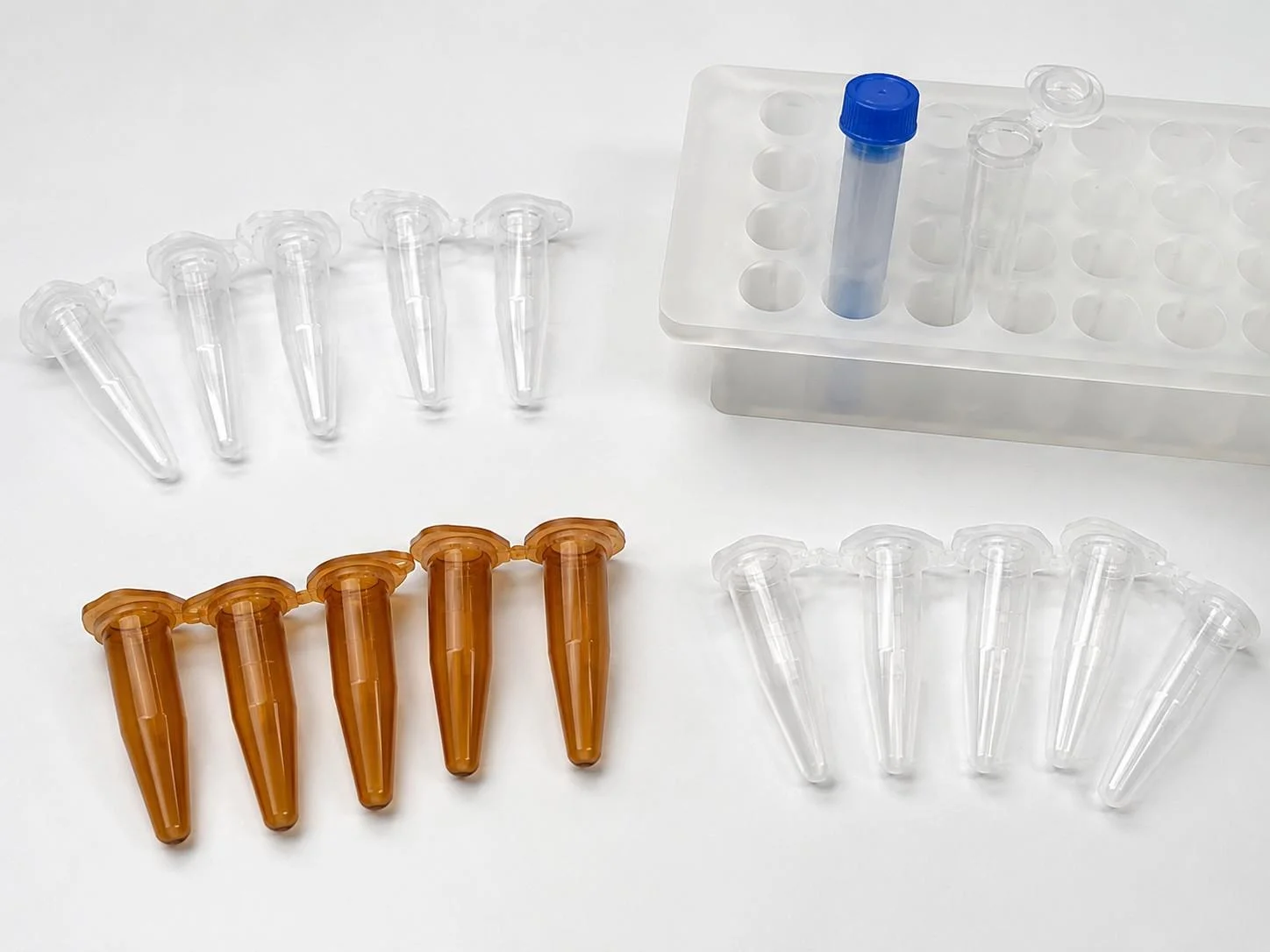
If you work in a laboratory, you use microcentrifuge tubes every day. These small conical plastic tubes hold samples during centrifugation, storage, and chemical reactions. They appear in clinical labs, university research departments, pharmaceutical companies, and forensic units worldwide. Despite their simple appearance, they are precision tools. The material, wall thickness, and cap design all affect how a sample behaves inside them.
Choosing the wrong tube causes real problems. You can lose sample, degrade nucleic acids, fail a PCR reaction, or contaminate results. This guide covers everything you need to know — sizes, types, materials, applications, and how to pick the right tube for your work.
Walk into any molecular biology lab in the world — in Boston, Berlin, Bangalore, or Beijing — and you will find the same small plastic tube sitting in a rack on the bench. It holds perhaps a milliliter of liquid. It costs a few cents. Yet it carries some of the most consequential work in modern science: extracting a cancer biomarker, amplifying a pathogen’s DNA, storing a patient’s sample for future analysis. The microcentrifuge tube is so common that most scientists never think about it. They probably should.
What Is a Microcentrifuge Tube?
A microcentrifuge tube is a small, conical, single-use plastic tube. Labs use it to hold liquid samples during centrifugation, storage, mixing, and reactions. The conical bottom collects pelleted material — such as cell debris or precipitated protein — at a single point. This makes recovery easier and more complete.
Many scientists call these tubes Eppendorf tubes. That name comes from the German company Eppendorf SE, which introduced the original 1.5 mL design in 1963. Today, dozens of manufacturers produce microcentrifuge tubes. Standard tubes withstand relative centrifugal forces (RCF) of up to 16,000 x g. High-performance versions handle 25,000 x g or more.
Microcentrifuge Tube Sizes: Which One to Use
Microcentrifuge tubes come in sizes from 0.2 mL to 5.0 mL. Each size suits specific applications. Using the correct volume ensures efficient centrifugation and prevents tube failure under high RCF. The table below gives a clear overview.
| Size | Best For | Rotor Compatibility | Common Applications |
| 0.2 mL | PCR strip tubes, thermal cycling | Fits standard PCR blocks | PCR, qPCR, small reactions |
| 0.5 mL | Small samples, pediatric specimens | Fits standard microcentrifuge rotor | Enzyme reactions, small aliquots |
| 1.5 mL | General purpose — most widely used size worldwide | Fits all standard rotors | DNA/RNA extraction, centrifugation |
| 2.0 mL | Larger volumes, bead beating, homogenization | Some rotors need an adapter | Genomic DNA, environmental samples |
| 5.0 mL | High-volume work, gradient separations | Requires high-speed compatible rotor | Gradient centrifugation, large aliquots |
The 1.5 mL tube is the most widely used size in the world. It fits all standard microcentrifuge rotors without an adapter. It also holds enough volume for most reaction setups and aliquoting workflows. As a result, virtually every lab supplier stocks it.
Microcentrifuge Tube Materials: Polypropylene vs Polystyrene
Polypropylene (PP) — The Standard Choice
Most microcentrifuge tubes consist of virgin polypropylene (PP). This material offers excellent chemical resistance, high tensile strength, and tolerance for autoclaving at 121°C. Polypropylene is translucent, so you can see the approximate liquid level inside the tube. It resists most acids, bases, and aqueous buffers common in molecular biology. In addition, its surface binds relatively little protein, making it suitable for most protein work. For very dilute or precious samples, however, low-retention variants work better.
Polystyrene (PS) — Limited Use Cases
Polystyrene tubes are fully transparent. This clarity helps when you need to inspect pellet formation or check for turbidity. However, polystyrene has poor chemical resistance. It degrades with organic solvents and cannot withstand autoclaving. For most laboratory tasks, polypropylene is the better choice. Polystyrene tubes suit cell culture and general biology work where chemical exposure stays minimal.
Low-Retention Polypropylene
Low-retention tubes use specially treated polypropylene with a hydrophobic inner surface. This surface reduces adsorption of proteins, enzymes, peptides, and nucleic acids onto the tube wall. Without this feature, a significant portion of a dilute sample sticks to the plastic and never reaches your assay. Therefore, low-retention tubes are essential when working with samples below 50 ng/mL. They also matter for single-cell analysis, antibody dilutions, and enzyme storage.
Types of Microcentrifuge Tubes and Their Applications
Beyond size and material, tubes differ in cap design, color, surface treatment, and special features. Choosing the right type prevents sample loss, contamination, and tube failure during centrifugation. The table below summarizes the main options.
| Tube Type | Best Application | Max RCF | Key Advantage |
| Standard (snap-cap) | General centrifugation, storage, routine work | Up to 16,000 x g | Most affordable; widely available |
| Safe-Lock (locking lid) | High-speed runs, autoclave, vortexing | Up to 25,000 x g | Lid locks under pressure; leak-proof |
| Screw-Cap | Long-term storage, freeze-thaw cycles, shipping | Up to 16,000 x g | Airtight seal; ideal for biobanking |
| Low-Retention | Proteins, enzymes, dilute nucleic acids | Up to 16,000 x g | Reduces sample loss on tube walls |
| PCR Strip Tubes (0.2 mL) | PCR, qPCR, thermal cycling | Thermal cycler only | Thin walls for rapid heat transfer |
| Amber / Light-Protective | Fluorescent dyes, RNA work, light-sensitive reagents | Up to 16,000 x g | Blocks UV and visible light |
| Graduated (with markings) | Volume measurement during prep | Up to 16,000 x g | Printed markings for quick estimates |
Standard Snap-Cap Tubes
Standard snap-cap tubes have an integrated hinged lid that closes with a simple press. They are the workhorse of the lab — inexpensive, widely available, and suitable for routine centrifugation and short-term storage. The snap closure holds well for most tasks. However, it may not seal fully under very high centrifugal force. For runs above 16,000 x g, always choose a safe-lock design instead.
Safe-Lock Tubes
Safe-lock tubes have a reinforced locking lid that clicks into a second locked position. The lid stays shut under high centrifugal force, during autoclaving, and during vigorous vortexing. It cannot open by accident. As a result, safe-lock tubes are the right choice for any run above 16,000 x g. They also work well when autoclaving samples in the tube or when a spill would mean losing irreplaceable material.
Screw-Cap Tubes
Screw-cap tubes provide an airtight, leak-proof seal. This makes them ideal for long-term storage, freeze-thaw cycling, and shipping of biological samples. The threaded cap compresses evenly around the tube opening. Many versions include an O-ring for extra sealing. These tubes work at -80°C and, with cryogenic-grade versions, in liquid nitrogen. Labs commonly use them for biobanking and sample archiving.
Low-Retention Tubes
Low-retention tubes are essential for precious, dilute, or sticky biological samples. They matter most in proteomics workflows, single-cell RNA sequencing, antibody preparations, and enzyme storage. They cost more than standard polypropylene tubes. For this reason, most labs reserve them for applications where wall adsorption would truly affect results.
Amber and Light-Protective Tubes
Amber tubes consist of pigmented polypropylene that blocks ultraviolet and visible light. Labs use them for light-sensitive compounds such as fluorescent dyes, SYBR Green stains, bilirubin standards, and photoreactive reagents. Without protection, these compounds degrade rapidly under normal lab lighting. Amber tubes give more reliable and consistent protection than wrapping clear tubes in aluminum foil.
Chemical Resistance of Microcentrifuge Tube Materials
Picking a tube material that matches your reagents is critical. An incompatible tube can degrade, leach plasticizers into your sample, or cause sample loss. The table below shows how the two main materials compare across common lab chemicals.
| Material | Acids | Bases | Organic Solvents | Ethanol | Acetone |
| Polypropylene (PP) | Excellent | Excellent | Good | Excellent | Poor |
| Polystyrene (PS) | Poor | Good | Poor | Good | Poor |
| Low-Retention PP | Excellent | Excellent | Good | Excellent | Poor |
Note: These ratings are general guidelines. Resistance varies with concentration, temperature, and exposure time. For critical applications involving strong solvents or concentrated acids, always check the manufacturer’s compatibility data sheet.
Common Laboratory Applications of Microcentrifuge Tubes
DNA and RNA Extraction
DNA and RNA extraction involves multiple centrifugation steps. Labs use these steps to separate cellular debris, precipitate nucleic acids, and wash away contaminants. The standard vessel for this work is a 1.5 mL polypropylene tube. Safe-lock tubes work best when protocols involve vigorous vortexing or high-speed centrifugation. For RNA work specifically, low-retention tubes reduce yield loss, especially when starting material is limited.
PCR and Quantitative PCR
PCR reactions use 0.2 mL thin-walled tubes or strip tubes. These fit directly into the wells of a thermal cycler block. The thin polypropylene walls transfer heat rapidly and evenly. This is critical for efficient denaturation, annealing, and extension steps. For qPCR, flat or domed optical caps allow fluorescence detection through the cap. Standard 1.5 mL tubes are not suitable for PCR because their thicker walls slow heat transfer and they do not fit standard PCR block formats.
Protein Work and Enzyme Storage
Proteins and enzymes bind readily to plastic surfaces. This causes activity loss in dilute samples and small volumes. For this reason, low-retention tubes are strongly recommended for protein quantification, enzyme dilution series, and antibody preparations. For enzyme storage, fill the tube to minimize headspace. This reduces freeze-thaw oxidation. Label each tube clearly with the enzyme name, concentration, date, and lot number.
Cell Pelleting and Washing
Labs use microcentrifuge tubes to pellet cells from suspension cultures, wash cells between staining steps, and concentrate bacteria or yeast from liquid cultures. The conical bottom forms the cell pellet at a single point. This lets you aspirate the supernatant cleanly without disturbing the pellet. For fragile cells, use low-speed centrifugation at 300 to 500 x g to avoid cell lysis. Safe-lock tubes are the right choice when working with infectious or biohazardous material.
Sample Aliquoting and Biobanking
Dividing a master sample into smaller aliquots protects sample integrity across multiple experiments. Repeated freeze-thaw cycles of a master stock degrade nucleic acids, proteins, and other biologicals. Aliquoting prevents this. Screw-cap tubes with O-rings are the best format for biobanking and frozen storage. Furthermore, labels must remain legible at -80°C. Use permanent ink or cryogenic-rated printed labels.
Clinical and Diagnostic Applications
In clinical diagnostics, labs use microcentrifuge tubes to aliquot patient serum or plasma, prepare nucleic acids for PCR-based pathogen detection, and store residual samples for quality assurance. Clinical-grade tubes must be free of DNase, RNase, pyrogens, and human DNA. For blood-based molecular diagnostics, serum or plasma first separates from cells in a vacutainer tube. The lab then transfers it to a 1.5 mL microcentrifuge tube for downstream processing.
One of the most common sources of unexplained experimental failure in molecular biology is the tube itself — not the reagents, not the protocol, not the instrument. A standard snap-cap tube used where a low-retention tube was needed. A polystyrene tube exposed to ethanol. A tube spun at 20,000 x g when the rating was only 16,000 x g. These are small decisions that feel minor in the moment. However, they become very significant when results cannot be reproduced. Getting the tube right is not overthinking — it is good science.
How to Choose the Right Microcentrifuge Tube
With many options available, selecting the right tube comes down to five key questions:
- What volume do I need? Choose a tube that holds your sample with at least 20 percent headspace to prevent leaks during centrifugation.
- What centrifugal force will I use? For runs above 16,000 x g, always use safe-lock tubes rated for the required RCF. Check the manufacturer’s maximum RCF before use.
- Is my sample light-sensitive? If yes, use amber tubes for fluorescent dyes, SYBR stains, bilirubin, or any photoreactive reagent.
- Am I working with dilute or precious samples? If so, use low-retention tubes for any sample below 50 ng/mL, for enzyme preparations, or for single-cell workflows.
- Do I need long-term or cryogenic storage? Use screw-cap tubes with O-rings and confirm the tube’s temperature rating matches your storage conditions.
Autoclaving and Sterilization of Microcentrifuge Tubes
Most polypropylene tubes tolerate autoclaving at 121°C for 15 to 20 minutes. However, polystyrene tubes melt and deform under these conditions. Always confirm that your tubes carry an autoclave-compatible label before placing them in the autoclave. During the cycle, keep caps loosened so steam can penetrate and pressure can equalize. A tightly sealed cap traps air and may pop open or deform.
For applications that require DNase-free or RNase-free tubes, autoclaving alone is not enough. Autoclaving does not inactivate RNases or endotoxins. Manufacturers eliminate these contaminants during production through DEPC treatment, gamma irradiation, or specialized cleaning. Therefore, for RNA work, always buy tubes with explicit RNase-free and DNase-free certification. Do not rely on autoclaving to achieve this standard.
Frequently Asked Questions (FAQs)
1. What is the difference between a microcentrifuge tube and an Eppendorf tube?
Eppendorf tube is a brand name that became a generic term in labs worldwide, much like Xerox became synonymous with photocopying. The Eppendorf company introduced the original 1.5 mL conical design in 1963, and the design spread globally. Today, scientists use both terms interchangeably. Technically, only tubes from Eppendorf SE are true Eppendorf tubes. All others are microcentrifuge tubes from various manufacturers built to the same general design.
2. Can labs reuse microcentrifuge tubes?
Microcentrifuge tubes are single-use consumables. Labs should not reuse them for molecular biology or clinical diagnostic work. Reusing tubes risks sample carryover, chemical residues from cleaning agents, and surface degradation that increases protein and nucleic acid binding. In addition, reused tubes may fail structurally under high centrifugal force. For non-critical tasks such as weighing dry chemicals, careful washing may allow limited reuse. However, this practice is never appropriate for clinical or molecular work.
3. What does RCF mean and how does it affect tube selection?
RCF stands for Relative Centrifugal Force, also written as x g (times the force of gravity). It measures the actual force a sample experiences during centrifugation. RCF depends on both rotor radius and rotational speed. Two centrifuges running at the same RPM produce very different RCF values if their rotor radii differ. For this reason, scientific protocols express centrifugation conditions in RCF rather than RPM. Standard snap-cap tubes handle up to 16,000 x g. Safe-lock tubes from quality manufacturers handle up to 25,000 x g. Exceeding a tube’s rated RCF can crack or shatter the tube inside the rotor, damage the centrifuge, and create a biohazard.
4. How should labs store unused microcentrifuge tubes?
Store unused tubes in their original packaging in a clean, dry area away from sunlight, heat, and chemical vapors. Polypropylene degrades slowly under prolonged UV exposure. Organic solvent vapors can also compromise the material over time. For RNase-free and DNase-free certified tubes, keep them in their sealed packaging until use. Once you open a bag, store it in a sealed zip-lock bag in a clean part of the lab. Never store tubes near open containers of solvents, acids, or bases.
5. What is the maximum temperature microcentrifuge tubes can handle?
Standard polypropylene tubes withstand temperatures from -80°C up to 121°C for autoclaving. Cryogenic-grade tubes tolerate -196°C for liquid nitrogen storage. For heat block or water bath incubations at 95°C or above, confirm your tubes carry a temperature rating for that range. Also secure the caps with a locking device or cap strip to prevent pop-opens under heat and pressure. PCR strip tubes handle rapid thermal cycling between 4°C and 98°C by design.
6. Are microcentrifuge tubes safe for storing human samples?
Yes, medical-grade polypropylene microcentrifuge tubes are safe for human biological samples including serum, plasma, extracted DNA, RNA, and urine aliquots. For clinical diagnostic use, however, the tubes must carry specific certifications. These include non-cytotoxic, heavy-metal-free, DNase-free, RNase-free, and pyrogen-free ratings. In the United States, tubes for clinical use should meet FDA standards. In Europe, CE marking applies. Standard research-grade tubes use the same base material but may lack these certifications. Do not use them for clinical sample storage without first verifying compliance.
Key Takeaways
- Microcentrifuge tubes are conical, single-use polypropylene tubes. They come in sizes from 0.2 mL to 5.0 mL. The 1.5 mL size is the global standard for most lab work.
- Polypropylene resists most chemicals, tolerates autoclaving, and binds less protein than polystyrene. It is the right material for almost all lab applications.
- Always use safe-lock tubes for centrifugation above 16,000 x g. Standard snap-cap lids can open under high force and cause sample loss or biohazard spills.
- Use low-retention tubes for dilute or precious samples. Proteins, enzymes, and nucleic acids below 50 ng/mL adsorb to standard tube walls and reduce your yield.
- Amber tubes protect light-sensitive reagents — including fluorescent dyes and SYBR stains — from degradation under normal lab lighting conditions.
- Autoclaving sterilizes tubes but does not remove RNases or endotoxins. For RNA work, always buy manufacturer-certified RNase-free tubes.
- Never reuse microcentrifuge tubes in molecular biology or clinical diagnostic applications. Contamination risk and surface degradation make reuse unsafe.
The microcentrifuge tube will probably never get the recognition it deserves. It is not glamorous. It is not the sequencer or the mass spectrometer that makes the headlines. But it holds the sample that feeds all of those instruments. In laboratory science, the quality of your output depends on the quality of your inputs — and your inputs start with your consumables. Choose them carefully.
Related Articles
For further reading on laboratory consumables and blood collection, explore these related posts:
- Blood Collection Tube Colors — a complete guide to vacutainer tube types, additives, and which tests require which tube
- EDTA Tube — how the purple-top anticoagulant tube works and which laboratory tests require EDTA
- Centrifuge — types of laboratory centrifuges, rotor selection, and how centrifugation works
- Lancet Needle — fingerstick blood collection devices used in point-of-care and home glucose monitoring
About This Article
Prepared by the LabCare Editorial Team, drawing on 14+ years of experience in the diagnostic laboratory industry. All health content is reviewed for factual accuracy before publication. Always consult a qualified healthcare professional for medical advice.
Disclaimer: This article is for general informational and educational purposes only. Product specifications, chemical resistance data, and centrifugation ratings are general references and may vary between manufacturers. Always consult the manufacturer’s product data sheet and your institution’s safety protocols before selecting consumables for critical or regulated laboratory applications.


