
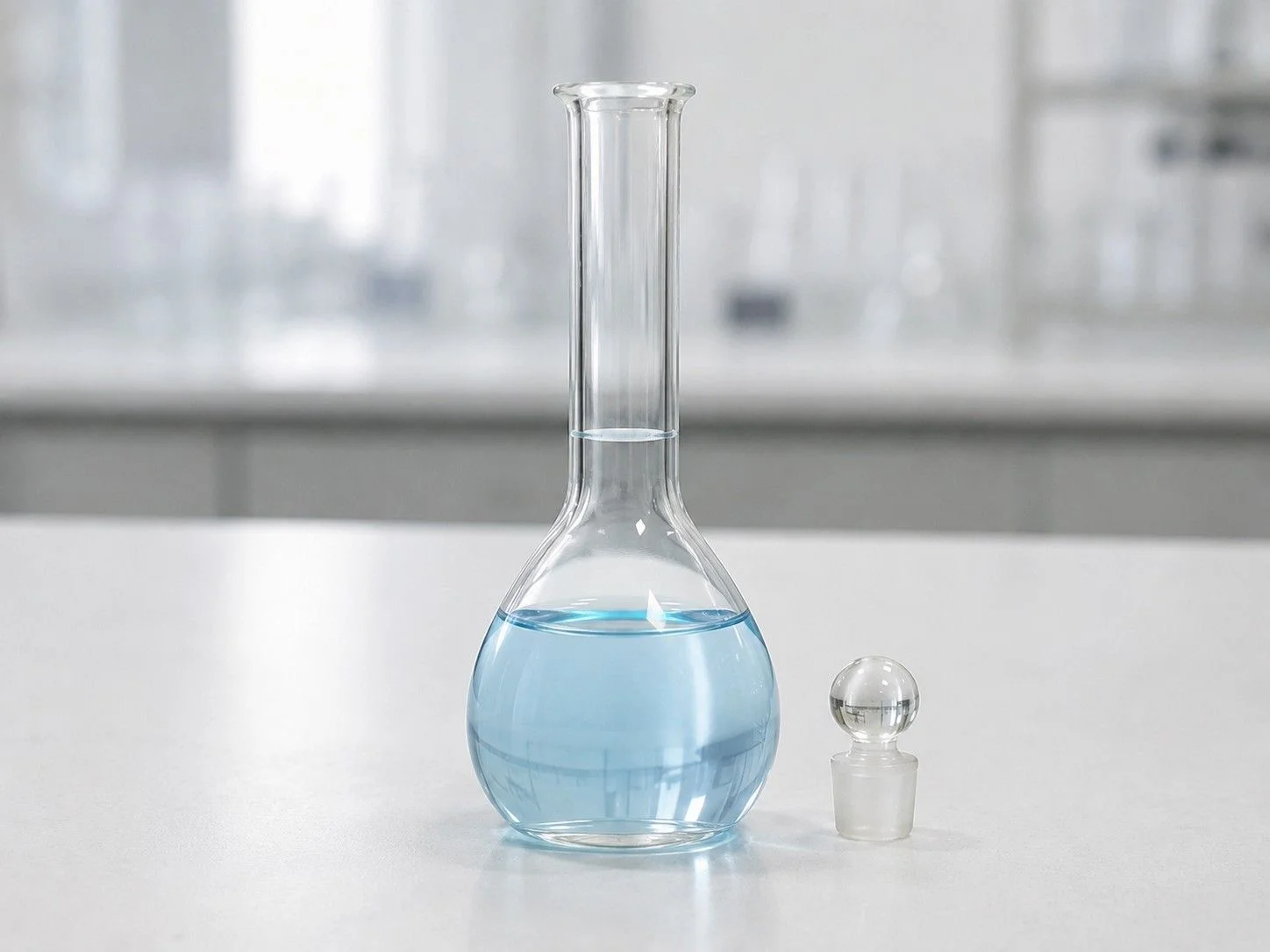
A volumetric flask is one of the most important pieces of glassware in any laboratory. Scientists use it to prepare solutions of an exact, known volume. You will find it in analytical chemistry labs, pharmaceutical quality control departments, clinical diagnostic labs, and university teaching labs worldwide. It looks simple — a round flat-bottomed bulb with a long narrow neck. However, its design delivers a level of accuracy that no beaker or graduated cylinder can match.
This guide explains what a volumetric flask is, how it works, and when to use it. You will also find size charts, material comparisons, a step-by-step usage guide, and answers to the most common questions about this essential lab tool.
Most lab equipment gets attention for its complexity — the sequencer, the mass spectrometer, the automated analyzer. The volumetric flask gets none of that attention. It has no moving parts, no electronics, and no software. However, it underpins almost every quantitative experiment in chemistry and biology. Get the flask wrong, and every measurement downstream is wrong too. That is why understanding this deceptively simple tool matters more than most people realize.
What Is a Volumetric Flask?
A volumetric flask is a flat-bottomed glass or plastic flask with a long narrow neck. Manufacturers etch a single calibration mark on the neck. When liquid fills the flask exactly to this mark, the flask holds a precise, certified volume at a specified temperature — usually 20°C. This single-mark design is what separates a volumetric flask from other glassware. Beakers and Erlenmeyer flasks carry approximate graduation marks. A volumetric flask carries one exact mark.
Labs use volumetric flasks primarily to prepare standard solutions. A standard solution has a precisely known concentration. For this reason, chemists dissolve a weighed solute in a small amount of solvent, transfer it to the flask, and then add solvent up to the calibration mark. This gives them a solution of exact concentration every time.
Parts of a Volumetric Flask
Understanding the parts of a volumetric flask helps you use it correctly. Each part serves a specific purpose.
- Bulb (body): The large round bottom section holds most of the solution volume. Its wide shape allows easy mixing by inversion.
- Neck: The long, narrow neck reduces the surface area at the calibration point. This makes the measurement highly sensitive to small volume changes. Even a fraction of a milliliter produces a visible change in the liquid level.
- Calibration mark: A single etched or printed line on the neck marks the exact calibrated volume. The bottom of the meniscus must sit precisely on this mark during preparation.
- Stopper: A ground glass or plastic stopper seals the flask. This prevents evaporation and contamination. It also allows safe mixing by inversion. Always use the stopper that comes with the flask, as stopper fit affects the seal quality.
- Flat base: The flat bottom keeps the flask stable on the bench during preparation.
Volumetric Flask Sizes: Complete Reference
Volumetric flasks come in a wide range of sizes. The right size depends on the volume of solution you need to prepare. Choosing too large a flask wastes reagent. Choosing too small a flask forces you to prepare multiple batches. The table below covers all common sizes and their applications.
| Size | Best For | Common Applications |
| 5 mL | Micro-scale chemistry, trace analysis | Analytical chemistry, pharmaceutical research |
| 10 mL | Small-volume standard solutions | Clinical labs, quality control |
| 25 mL | Diluting small reagent volumes | Titration prep, standard solution making |
| 50 mL | Moderate-volume preparations | Routine lab work, buffer preparation |
| 100 mL | Standard solution preparation | Most common size in teaching and research labs |
| 250 mL | Medium-volume solutions | General chemistry, microbiology media prep |
| 500 mL | Large batches of standard solutions | Industrial labs, pharmaceutical QC |
| 1000 mL (1 L) | High-volume reagent preparation | Manufacturing, large-scale research |
| 2000 mL (2 L) | Very large volume preparations | Industrial chemistry, large-scale QC labs |
The 100 mL flask is the most common size in both teaching and research labs. It suits standard solution preparation, calibration standards, and routine analytical work. For pharmaceutical and industrial QC, the 250 mL and 500 mL sizes are also widely used.
Class A vs Class B Volumetric Flasks
All volumetric flasks carry a class designation — Class A or Class B. This classification defines how accurately the flask measures volume. Choosing the wrong class for your application leads to errors in concentration that compound throughout your analysis.
| Feature | Class A | Class B |
| Accuracy | Highest — meets international standards (ISO, ASTM) | Lower — suitable for general lab work |
| Tolerance (100 mL) | ±0.10 mL | ±0.20 mL |
| Tolerance (1000 mL) | ±0.40 mL | ±0.80 mL |
| Calibration Certificate | Often supplied with batch certificate | Not usually supplied |
| Temperature Calibration | 20°C standard | 20°C standard |
| Suitable For | Analytical chemistry, pharmaceutical QC, research | Teaching labs, general prep work |
| Material | Borosilicate glass (typically) | Borosilicate glass or soda-lime glass |
| Cost | Higher | Lower |
| Color Code (stopper) | Clear or orange | White or blue |
For all analytical work, pharmaceutical quality control, and regulatory testing, always use Class A flasks. Class B flasks work well for teaching labs and general preparation where high precision is not critical. However, never substitute a Class B flask in a method that specifies Class A. The tolerance difference — double in Class B — directly affects your results.
Glass vs Plastic Volumetric Flasks
Volumetric flasks come in two main materials: borosilicate glass and plastic. Each has clear advantages and limitations. The right choice depends on your application, your reagents, and your working environment.
| Feature | Glass (Borosilicate) | Plastic (PMP/PP) |
| Material | Borosilicate glass | Polymethylpentene (PMP) or polypropylene (PP) |
| Optical Clarity | Fully transparent | Semi-transparent (PMP) or opaque (PP) |
| Chemical Resistance | Excellent — resists most acids, bases, solvents | Good for aqueous solutions; poor with organic solvents |
| Temperature Resistance | Up to 500°C (dry heat) | Up to 120°C (most grades) |
| Autoclavable | Yes | Yes (PP grade); check manufacturer for PMP |
| Breakage Risk | High — shatters if dropped | None — unbreakable |
| Accuracy | Higher — preferred for Class A work | Slightly lower than glass |
| Cost | Moderate | Higher per unit than equivalent glass |
| Best Use | Analytical and research labs | Field work, schools, safety-conscious environments |
In most analytical and research labs, borosilicate glass is the standard choice. It offers superior chemical resistance and optical clarity. However, plastic flasks are safer in environments where breakage is a concern — such as teaching labs with students, field research settings, or labs working near sensitive equipment. Furthermore, plastic is the right choice when working with hydrofluoric acid (HF), which attacks and etches glass.
How to Use a Volumetric Flask: Step-by-Step
Using a volumetric flask correctly is essential for accurate solution preparation. Follow these steps in order for reliable results every time.
Step 1 — Weigh or measure your solute
Weigh your solid solute on an analytical balance. Use a weighing boat or weighing paper. Transfer the weighed solid directly into a clean beaker — not into the volumetric flask. If you use a liquid solute, measure it with a pipette or graduated cylinder first.
Step 2 — Dissolve the solute
Add a small volume of solvent — about one-third of the final volume — to the beaker. Stir or swirl gently until the solid fully dissolves. Make sure no undissolved particles remain before you proceed. For solutes that dissolve slowly, gentle heating on a hotplate helps. However, allow the solution to cool to room temperature before transferring it to the flask.
Step 3 — Transfer to the volumetric flask
Pour the dissolved solution carefully into the volumetric flask through a glass funnel. Rinse the beaker three times with small amounts of solvent. Add each rinsing to the flask. This ensures complete transfer of all solute. Remove the funnel after transferring.
Step 4 — Add solvent to near the mark
Add solvent slowly to the flask until the liquid level reaches about 1 to 2 cm below the calibration mark. At this point, switch to a dropper or wash bottle for fine control. This prevents overshooting the mark.
Step 5 — Adjust to the calibration mark
Hold the flask at eye level. Add solvent drop by drop until the bottom of the meniscus sits exactly on the calibration mark. For colored solutions, align the top of the meniscus with the mark instead. Do not look up or down at the mark — parallax error will give you a wrong reading.
Step 6 — Stopper and mix
Insert the stopper firmly. Hold the stopper in place with your thumb or index finger. Invert the flask slowly ten to fifteen times. Rotate it gently while inverted to ensure complete mixing. The solution is now ready to use.
Important cautions
Never heat a volumetric flask directly on a hotplate or flame. The glass expands unevenly and the calibration mark becomes inaccurate. Also, never store solutions in a volumetric flask long-term. Transfer the prepared solution to a labeled reagent bottle for storage. Finally, always check the temperature — volumetric flasks are calibrated at 20°C. Preparing a solution at a significantly different temperature introduces volume error.
Common Laboratory Applications
Preparing Standard Solutions
The primary use of a volumetric flask is preparing standard solutions — solutions of precisely known concentration. Analysts use standard solutions to calibrate instruments, validate methods, and run quality control checks. For example, a 0.1 mol/L sodium hydroxide standard solution needs exactly the right amount of NaOH dissolved and made up to exactly 1000 mL. A volumetric flask is the only glassware that delivers this level of precision reliably.
Serial Dilutions
Labs use volumetric flasks to prepare serial dilutions from a concentrated stock solution. A precise volume of the stock solution transfers to the flask using a volumetric pipette. The analyst then makes up the volume to the mark with solvent. This gives an exact dilution factor. As a result, serial dilutions prepared with volumetric flasks are far more accurate than those done with beakers or graduated cylinders.
Pharmaceutical Quality Control
In pharmaceutical labs, every standard solution used for testing drug potency, impurity profiles, or dissolution must meet strict regulatory standards. Analysts prepare these solutions in Class A volumetric flasks. Regulatory agencies including the FDA and EMA require this level of precision in pharmacopoeial testing methods. Therefore, pharmaceutical QC labs keep large inventories of Class A flasks in multiple sizes.
Clinical Diagnostic Labs
Clinical labs use volumetric flasks to prepare calibration standards and reagent solutions for analyzers. For instance, a glucose standard solution or a creatinine calibrator must have an exact concentration. Any error in the standard directly shifts all patient results. As a result, clinical lab standards are almost always prepared in Class A volumetric glassware.
Titration
Titration requires a solution of exactly known concentration — called a titrant. Labs prepare titrants in volumetric flasks before transferring them to burettes. The accuracy of a titration result depends entirely on how accurately the analyst prepared the titrant. For this reason, volumetric flasks are a critical part of every titration workflow.
Volumetric Flask vs Erlenmeyer Flask vs Beaker
Students and new lab workers often confuse these three pieces of glassware. However, they serve very different purposes. Using the wrong vessel introduces significant errors into your work. The table below clarifies the key differences.
| Feature | Volumetric Flask | Erlenmeyer Flask | Beaker |
| Primary Purpose | Prepare precise volumes of solution | Mixing, heating, titration | General mixing, heating, pouring |
| Volume Accuracy | Very high (±0.10–0.40 mL) | Low — graduation marks are approximate | Very low — graduation marks are rough estimates |
| Shape | Flat-bottomed bulb with long narrow neck | Conical body with narrow neck | Cylindrical with wide opening |
| Stopper / Cap | Ground glass or plastic stopper | No stopper (open top) | No stopper (open top) |
| Graduation Marks | Single calibration mark on neck | Multiple approximate marks | Multiple approximate marks |
| Used for Heating | No — not designed for direct heat | Yes — safe on hotplate or flame | Yes — safe on hotplate or flame |
| Best For | Standard solution preparation, volumetric analysis | Reactions, titrations, mixing | Rough measurements, heating, storage |
The key rule is simple: use a volumetric flask when you need an exact volume. Use an Erlenmeyer flask when you need to mix or react solutions. Use a beaker when you need to heat liquids or make rough measurements. Never use a beaker or Erlenmeyer flask to prepare a standard solution — the volume error is too large.
A note that experienced chemists learn early and students often learn the hard way: a volumetric flask is a calibrated instrument, not just a container. The calibration mark is only accurate at 20°C, with the specific meniscus technique described above, and with a flask that has no chips, etchings, or residue on the glass. Treat it accordingly. A scratched calibration mark or a flask dried in the oven is no longer a Class A volumetric flask — it is just an expensive bottle.
Care, Cleaning, and Storage of Volumetric Flasks
Cleaning
Rinse the flask immediately after use with distilled water. For most solutions, three rinses with distilled water remove residue effectively. For stubborn residues, use a mild lab detergent and a long-handled brush. Rinse thoroughly after detergent washing — any detergent residue affects your next solution. For organic residues, a brief soak in a suitable solvent (such as acetone for grease) followed by distilled water rinses works well. Never use chromic acid cleaning solution on volumetric flasks. Chromic acid etches the glass surface and damages the calibration mark over time.
Drying
Do not dry volumetric flasks in an oven. High heat changes the shape of the glass slightly. This shifts the calibrated volume and makes the flask inaccurate. Instead, allow flasks to drain and air-dry at room temperature. If you need a dry flask quickly, rinse it twice with small amounts of acetone after the final water rinse. Then blow dry air through the neck. This removes residual water rapidly without heating the glass.
Storage
Store volumetric flasks upright with their stoppers loose or removed. A tightly inserted stopper traps moisture and can cause the stopper to seize in the neck — especially with ground glass stoppers. Store flasks away from direct sunlight and away from strong reagents that produce fumes. Label each flask clearly with its volume and class. Also, inspect flasks regularly for chips, cracks, or etching on the calibration mark. Discard any damaged flask immediately. A damaged flask gives inaccurate volumes and poses a breakage risk.
Frequently Asked Questions (FAQs)
1. Why does a volumetric flask have only one graduation mark?
A single calibration mark makes the flask far more accurate than glassware with multiple marks. Adding more marks to the narrow neck would require the marks to sit very close together. This makes reading the correct volume difficult and increases the risk of parallax error. The single mark also reflects the flask’s purpose: preparing one specific volume with maximum precision. If you need a different volume, you use a different flask. This approach gives each flask one job and one calibration point, which delivers the highest possible accuracy.
2. Can you heat a volumetric flask?
No. Never heat a volumetric flask directly on a hotplate, over a flame, or in an oven. Glass expands when heated. Even small temperature changes alter the internal volume of the flask and shift the calibration mark away from its certified volume. For this reason, dissolve your solute in a beaker first, allow the solution to cool to room temperature, and then transfer it to the volumetric flask for final volume adjustment. The only exception is hot distilled water used to rinse the inside of the flask during cleaning — this is acceptable because you drain the water before using the flask for measurement.
3. What is the meniscus and how do you read it correctly?
The meniscus is the curved surface of a liquid in a narrow vessel. In most aqueous solutions in glass, the meniscus curves downward in the center — this is called a concave meniscus. To read a volumetric flask correctly, hold the flask at eye level. The bottom of the meniscus must sit exactly on the calibration mark. If you look up at the mark, you will under-fill the flask. If you look down, you will over-fill it. This error is called parallax error. For colored solutions that obscure the bottom of the meniscus, align the top of the meniscus with the mark instead.
4. What is the difference between ‘to contain’ and ‘to deliver’ glassware?
Volumetric flasks are ‘to contain’ (TC) glassware. This means the calibrated volume is the volume held inside the flask when filled to the mark. Pipettes and burettes are ‘to deliver’ (TD) glassware. They deliver the calibrated volume when the liquid drains out. This distinction matters when you transfer solution from a volumetric flask to another vessel. The solution in the flask equals the stated volume. However, a thin film of solution remains on the glass walls after pouring. As a result, you should never rinse a volumetric flask into a container and assume you transferred exactly the stated volume.
5. How do you prepare a solution from a liquid solute in a volumetric flask?
First, calculate the volume of liquid solute you need using the formula: volume = (desired concentration x final volume) / stock concentration. Measure this volume using a volumetric pipette — not a graduated cylinder. Transfer the measured liquid to the volumetric flask. Add solvent carefully to bring the total volume up to the calibration mark. Stopper the flask and invert it ten to fifteen times to mix. If you add the liquid solute directly to the volumetric flask without pre-diluting it, heat of mixing can occur. This temporarily changes the volume and gives an inaccurate final concentration.
6. How long can you store a solution in a volumetric flask?
Volumetric flasks are preparation vessels, not storage vessels. After you prepare a solution, transfer it to an appropriately labeled reagent bottle for storage. Storing solutions in volumetric flasks creates several problems. First, the ground glass stopper can seize if left inserted for long periods, especially with alkaline solutions that etch glass. Second, evaporation through the stopper seal changes the concentration over time. Third, leaving corrosive or reactive solutions in expensive calibrated glassware risks damage. For short-term use — same day or next day — leaving the solution in the flask is acceptable. For anything longer, always transfer and label a storage bottle.
Key Takeaways
- A volumetric flask prepares solutions of exactly known volume. Its single calibration mark on the narrow neck gives far higher accuracy than beakers, graduated cylinders, or Erlenmeyer flasks.
- Always read the meniscus at eye level. The bottom of the meniscus must sit exactly on the calibration mark to achieve the certified volume accuracy.
- Class A flasks are mandatory for analytical chemistry, pharmaceutical QC, and regulatory testing. Class B flasks suit teaching labs and general preparation work only.
- Never heat a volumetric flask directly. Heat changes the glass shape and shifts the calibration mark, making the flask inaccurate.
- Borosilicate glass is the standard material for accuracy and chemical resistance. However, plastic flasks are safer in teaching labs and field settings, and are essential when working with hydrofluoric acid.
- Volumetric flasks are preparation vessels, not storage vessels. Always transfer your prepared solution to a labeled reagent bottle after preparation.
- Store flasks with stoppers loose or removed. A tightly sealed stopper traps moisture and can seize in the neck, especially with ground glass fittings.
There is a reason the volumetric flask has remained essentially unchanged for over a century. The design is already optimized. The flat base keeps it stable. The narrow neck amplifies small volume differences into visible meniscus changes. The round bulb makes mixing by inversion easy and complete. Every feature solves a specific problem. The next time you prepare a standard solution, take a moment to appreciate that the tool in your hand has barely changed since the early days of analytical chemistry — because it did not need to.
Related Articles
For more guides on laboratory equipment and consumables, explore these related posts:
- Centrifuge — types of laboratory centrifuges, rotor selection, and centrifugation principles
- Microcentrifuge Tube — sizes, materials, and how to choose the right tube for your application
- Lancet Needle — fingerstick blood collection devices used in point-of-care testing
- Blood Collection Tube Colors — which vacutainer tube to use for which laboratory test
About This Article
Prepared by the LabCare Editorial Team, drawing on 14+ years of experience in the diagnostic laboratory industry. All health content is reviewed for factual accuracy before publication. Always consult a qualified healthcare professional for medical advice.
Disclaimer: This article is for general informational and educational purposes only. Specifications, tolerances, and material properties described are general references and may vary between manufacturers and standards bodies. Always consult the manufacturer’s product data sheet, your institution’s standard operating procedures, and applicable regulatory guidelines before selecting glassware for critical or regulated laboratory applications.


